Every business owner is digging for the same treasure — an AI that actually knows their business. Not a chatbot. A brain. This room hands you the map: every step written out, every prompt ready to copy, nothing to break.
Walk in slowly · Nothing here can breakThe story is always the same. Someone hears there's a tool that will change everything, walks into a jungle of apps and jargon, and turns back inside an hour. The treasure everyone is digging for — an AI that already knows you — starts to sound like a legend.
It isn't. The c1ub found it, mapped it, and cut the path. Two free apps, one folder, about twenty minutes. Meet the two characters in this story:
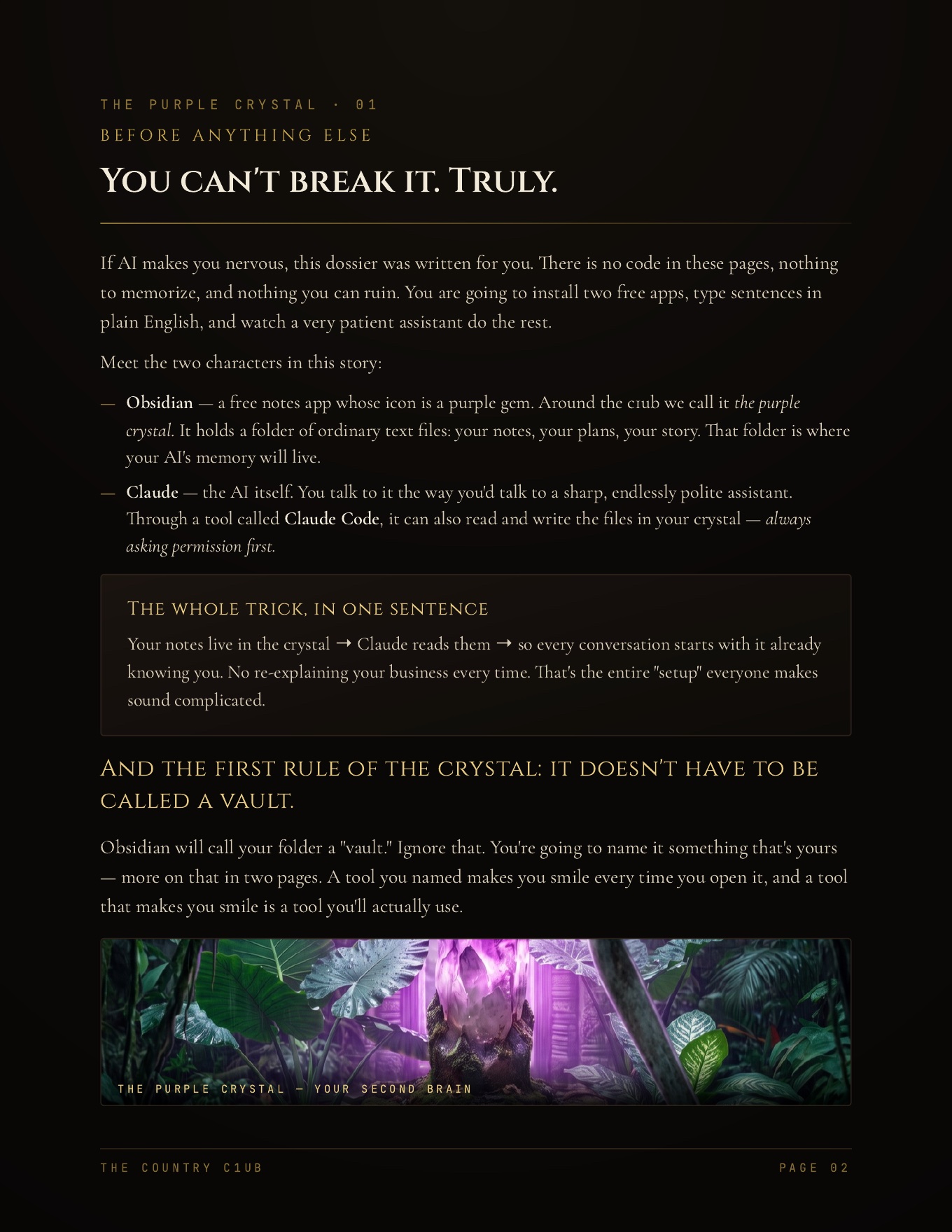
Obsidian — a free notes app whose icon is a purple gem. Around the c1ub we call it the purple crystal. It holds ordinary text files: your notes, your plans, your story. And Claude — the caddie. Through a tool called Claude Code it reads and writes the files in your crystal, always asking permission first.
The full dossier — seven pages, on the shelf belowYour notes live in the crystal → Claude reads them → every conversation starts with it already knowing you.
No re-explaining your business every time. That's the entire "setup" everyone makes sound complicated. There is no code in this room, nothing to memorize, and nothing you can ruin. Press play — one minute, and the whole idea clicks.
Four things happen when a business finally gets a brain of its own. The old ones carved them above the door.

Every client, every price, every decision — filed forever, in plain files you can open and read yourself. Nothing important lives only in your head anymore.
Your head gets promoted. It stops being the filing cabinet and goes back to being the founder.
Ask about March. It remembers March.

Ten scattered apps and a full head, traded for one organized vault. Your plans, your people, your numbers — arranged so your caddie can always hand you the right iron.
Order isn't tidiness. Order is speed the day you need something fast.
One folder. Everything findable.

Most tools wear out. This one compounds — every conversation leaves something behind, and the crystal you talk to next month knows more than the one you named today.
That's the quiet magic of the memory loop you'll learn below: nothing is ever explained twice.
Next week's caddie is smarter than this week's.

Set up right, it multitasks: drafting your words, watching your numbers, holding your plans — while you do the work only you can do.
One of you walks into this room. A crew walks out.
You stop being the bottleneck of your own business.

Four short legs, in order. Copy the prompts word for word — Claude does everything else, and asks before it touches anything.
Two field films already hang in this room — more lesson films arrive as they're remastered

Two free apps. One folder. This is the whole install:
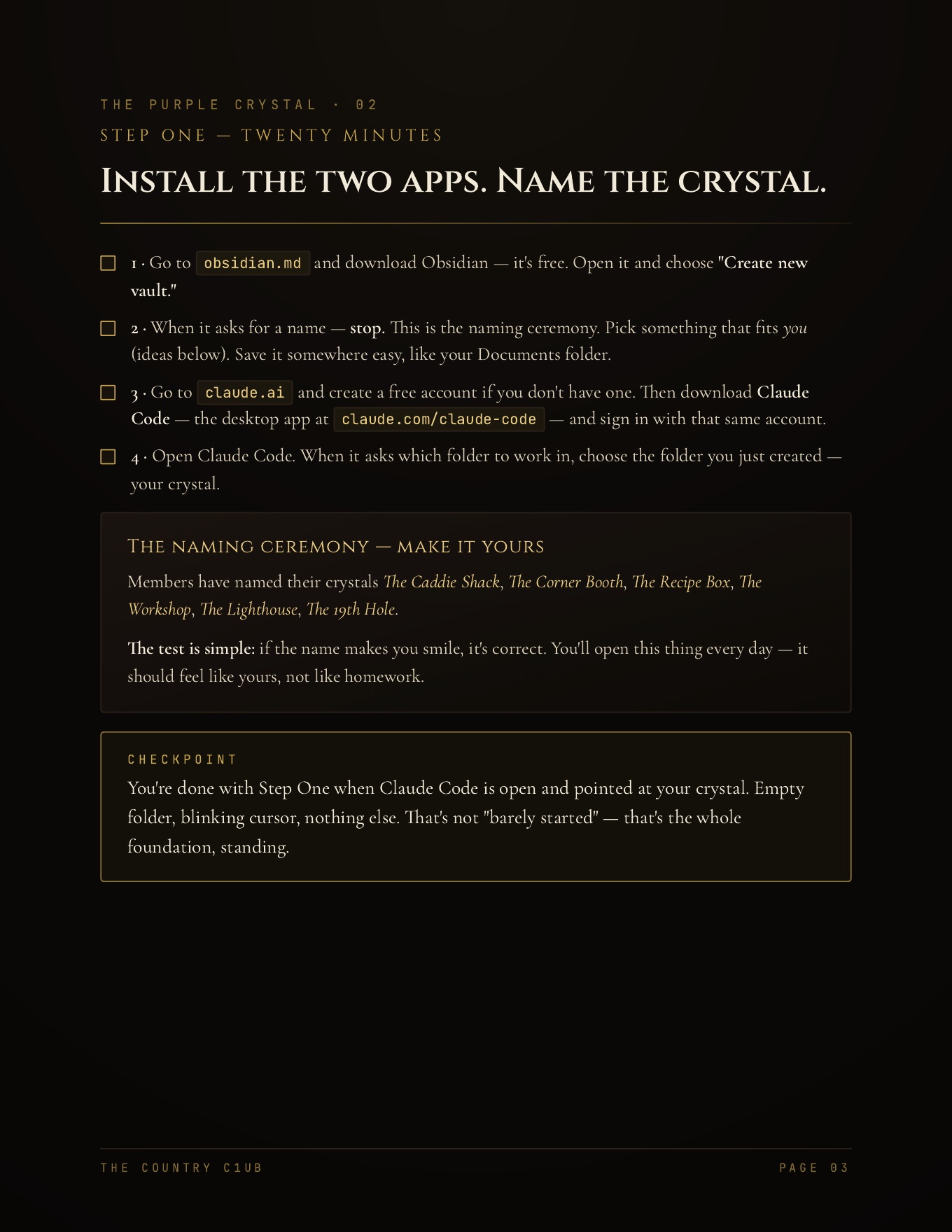
Go to obsidian.md and download Obsidian — it's free. Open it and choose "Create new vault."
When it asks for a name — stop. This is the naming ceremony. Pick something that fits you, and save it somewhere easy, like your Documents folder.
Go to claude.ai and create a free account if you don't have one. Then download Claude Code — the desktop app at claude.com/claude-code — and sign in with that same account.
Open Claude Code. When it asks which folder to work in, choose the folder you just created — your crystal.
Obsidian will call your folder a "vault." Ignore that. Members have named theirs The Caddie Shack, The Corner Booth, The Recipe Box, The Lighthouse, The 19th Hole. Name it here and every prompt on this page rewrites itself around your crystal. The test is simple: if the name makes you smile, it's correct.
You're done with this leg when Claude Code is open and pointed at your crystal. Empty folder, blinking cursor, nothing else. That's not "barely started" — that's the whole foundation, standing.

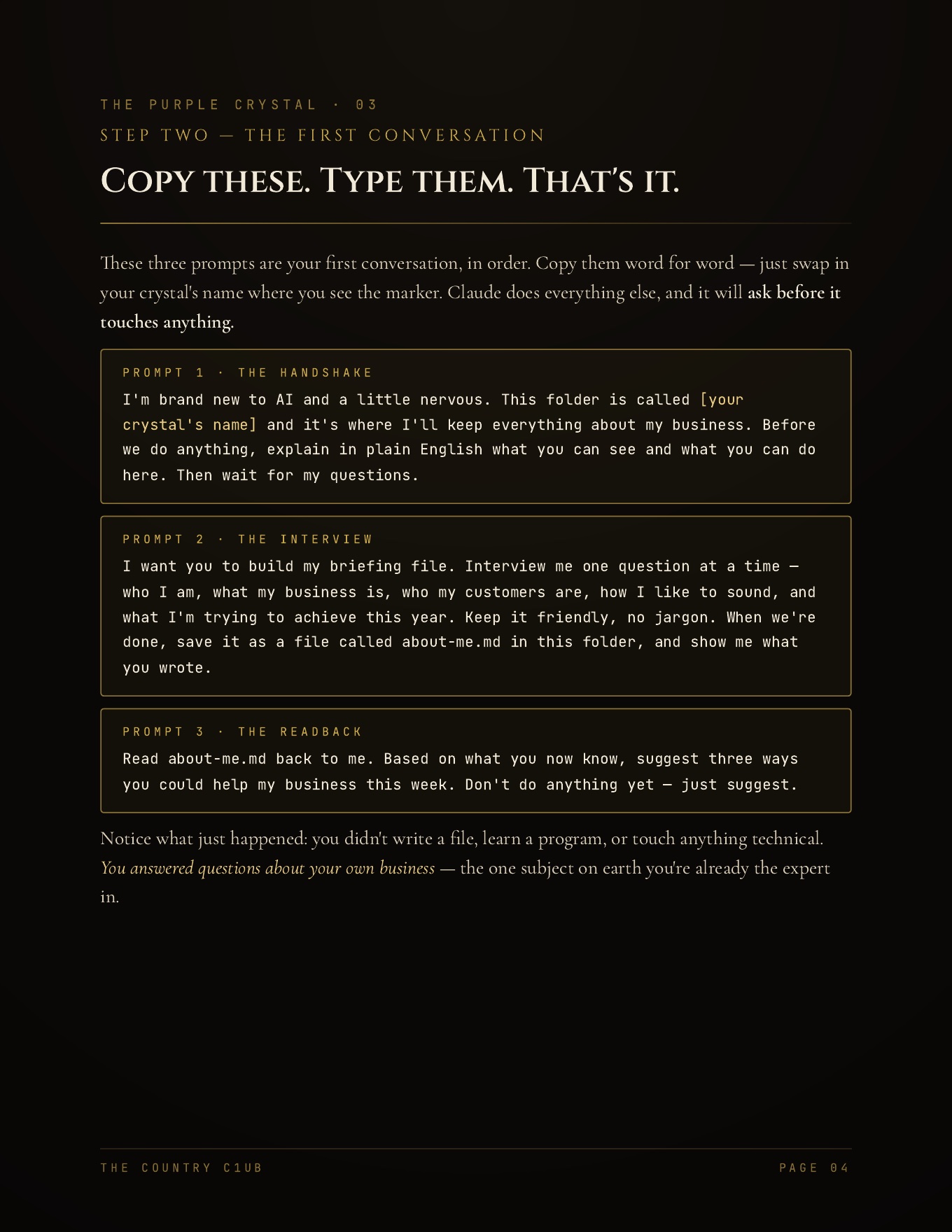
Copy these. Type them. That's it — in order, word for word. Claude asks before it touches anything.
I'm brand new to AI and a little nervous. This folder is called [your crystal's name] and it's where I'll keep everything about my business. Before we do anything, explain in plain English what you can see and what you can do here. Then wait for my questions.
I want you to build my briefing file. Interview me one question at a time — who I am, what my business is, who my customers are, how I like to sound, and what I'm trying to achieve this year. Keep it friendly, no jargon. When we're done, save it as a file called about-me.md in this folder, and show me what you wrote.
Read about-me.md back to me. Based on what you now know, suggest three ways you could help my business this week. Don't do anything yet — just suggest.
Notice what just happened: you didn't write a file, learn a program, or touch anything technical. You answered questions about your own business — the one subject on earth you're already the expert in.

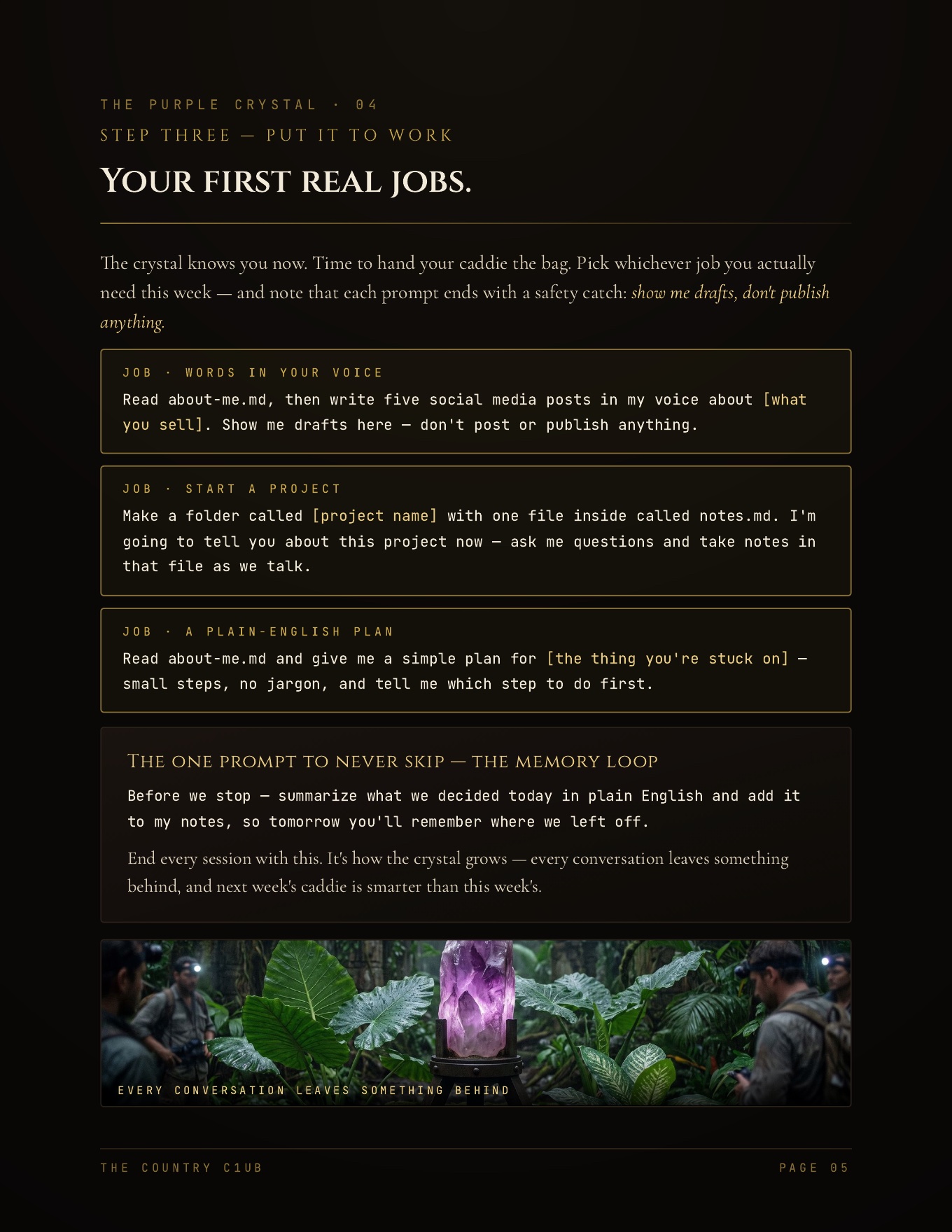
The crystal knows you now. Pick whichever job you actually need this week — each one ends with a safety catch: show me drafts, don't publish anything.
Read about-me.md, then write five social media posts in my voice about [what you sell]. Show me drafts here — don't post or publish anything.
Make a folder called [project name] with one file inside called notes.md. I'm going to tell you about this project now — ask me questions and take notes in that file as we talk.
Read about-me.md and give me a simple plan for [the thing you're stuck on] — small steps, no jargon, and tell me which step to do first.
Before we stop — summarize what we decided today in plain English and add it to my notes, so tomorrow you'll remember where we left off.
End every session with the memory loop. It's how the crystal grows — every conversation leaves something behind, and next week's caddie is smarter than this week's.

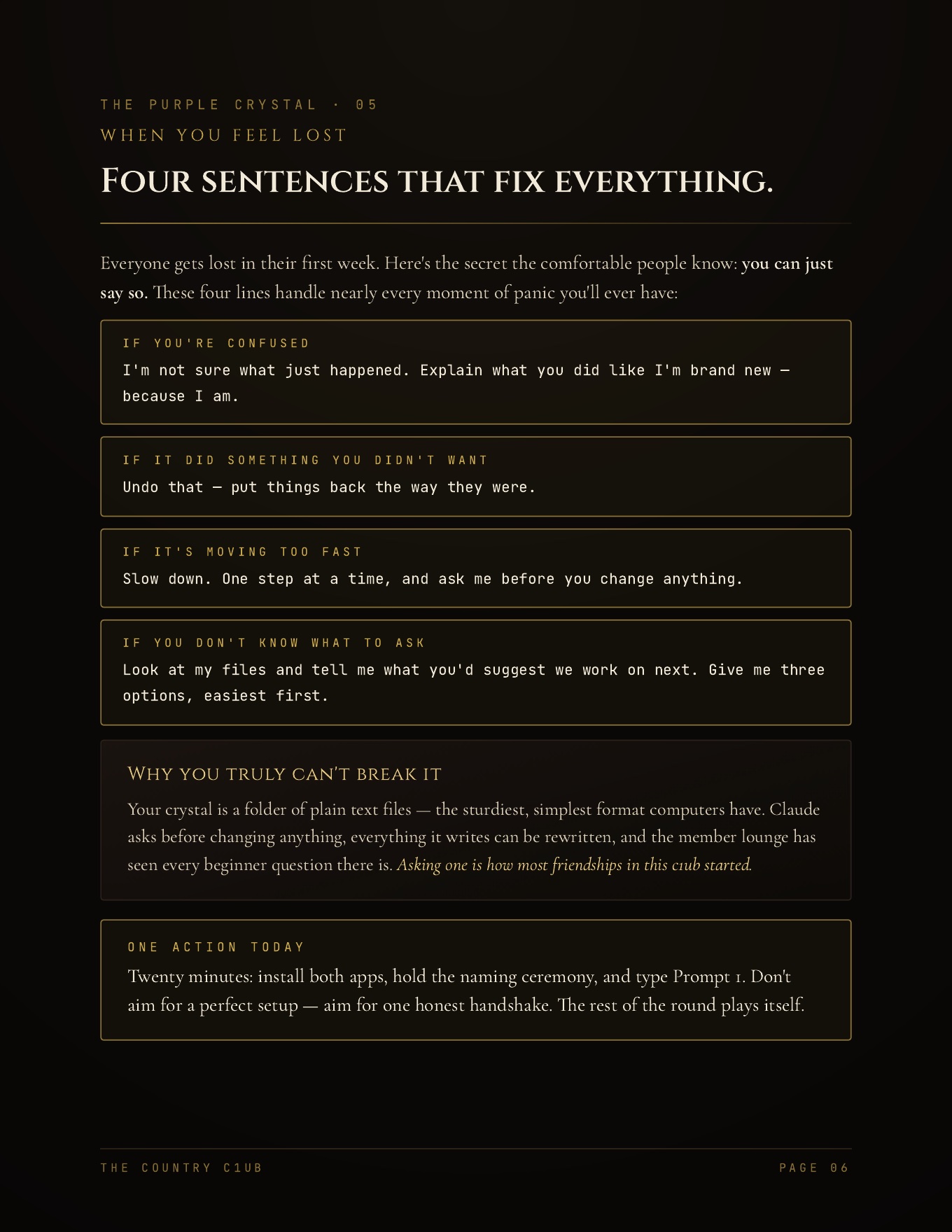
Everyone gets lost in their first week. Here's the secret the comfortable people know: you can just say so. These four sentences handle nearly every moment of panic you'll ever have:
I'm not sure what just happened. Explain what you did like I'm brand new — because I am.
Undo that — put things back the way they were.
Slow down. One step at a time, and ask me before you change anything.
Look at my files and tell me what you'd suggest we work on next. Give me three options, easiest first.
Your crystal is a folder of plain text files — the sturdiest, simplest format computers have. Claude asks before changing anything, everything it writes can be rewritten, and the member lounge has seen every beginner question there is. Asking one is how most friendships in this c1ub started.
Eight strokes from stranger to founder-with-a-brain. Tick them as you go — the card remembers, and nobody sees it but you.
The first tee is the naming ceremony — twenty minutes, start to finish.
Played your first round? Say it in The Conversations →
Marks stay on this device · One honest handshake beats a perfect setup
Seven pages, written for the member who has never touched AI. Turn the pages below — or take the PDF for your own shelf.


Classroom dossier — The Caddie · Part III · The whole shelf waits in The Study
This dossier is the c1ub's copy — every member reads the same seven pages. But finish two things and the bench cuts one more, just for you.
Complete your Spotlight and furnish your locker, and the c1ub will build a custom edition of this dossier around you and your projects — your business in the briefing page, every prompt pre-loaded with your real facts, your name on the cover. One of one.
When both are done, write to the Secretary — dani@thecountryc1ub.com — and the bench takes your commission.

Twenty minutes, one naming ceremony, one honest handshake. Nobody starts comfortable — they start.
Name it something that makes you smile. — Cameron, Founder